The Gift of Wisdom

“Behold, I send you out as sheep in the midst of wolves; so be wise as serpents and innocent as doves.”  These words of Jesus appear in Matthew 10:16 of the New Testament.  Jesus is speaking to his disciples as he directs them to travel to other cities and regions and to share the teachings he has taught to them.  As they travel and teach, some people will welcome them but others will not and will even try to harm them, which is why Jesus gives them the serious counsel he does.

When I am trying to discern how to approach a certain situation or undertaking, I remind myself of Jesus’ words, especially the guidance to be wise as serpents.  Wisdom is one of the attributes snakes symbolize in dreams, art, and literature.  Something I’ve needed to work on over the years is my tendency to be a “good girl.”  Good girls, and there are good boys too, are people who have a strong need for approval from others.  In order to acquire that approval, they readily say yes to requests or agree with what someone else says rather than giving it some thought before responding.  For many of us, it’s a holdover from having been children for whom obedience came easily.  But there’s a difference between being an obedient child and being an adult who uses the intelligence and wisdom he or she has been given.

Our inner voice is the source of wisdom that will help us to make decisions and guide our actions.  Therefore, it’s essential to try to listen to that voice and act on what we discern.  Doing so will enable us to be on our paths and to do those things we were created to do.

The Divine Presence

Many religious traditions teach the same or similar beliefs.  There’s an overlap in the truths they impart.  Some of these teachings are that there is an all-knowing and all-powerful divine presence and that having compassion, being humble, avoiding being judgmental, and helping others are qualities we should embrace.

Some people find it hard to believe in a divine presence.  In my work as a crisis line counselor, people sometimes call about their struggles with addiction and trying to maintain sobriety.  Although thankfully many people have been helped by attending Alcoholics Anonymous or Narcotics Anonymous meetings, some tell me they don’t consider attending those programs because they don’t believe in a higher power.  I understand having doubts.  Although I was raised in a religious tradition and attended worship services and religious instruction classes regularly throughout my childhood and teen years, I went through a period of questioning when I was in my 20s.  Questioning when a person is a young adult is natural to that time of life.  And it can happen at any age.  Most religious traditions have compassion for people as they struggle with their beliefs.

In modern western society, the rational/materialistic approach to life is emphasized.  Using our rational thinking abilities is essential for many tasks.  But the thinking, analytic function definitely does not provide all the answers.  There are many subjective, intangible aspects of life for which there are not clear, concise, objective explanations.  Some people ridicule a person who says there are not obvious explanations and that at times we do well to accept that there are mysteries.

Having faith is a gift from the Creator, the divine presence.  Although we are not directly in control of when we will be given that gift, it is important that we “prepare the soil,” so to speak, to receive it.  Trying to follow the almost universal teachings of having compassion, not judging others, having humility, and not thinking only of our needs and wants but remembering we are part of the human community are ways to do that.

Be open to the divine.  Then prepare the soil to receive the gift of faith, to care for it, and to help it grow.

Being Patient

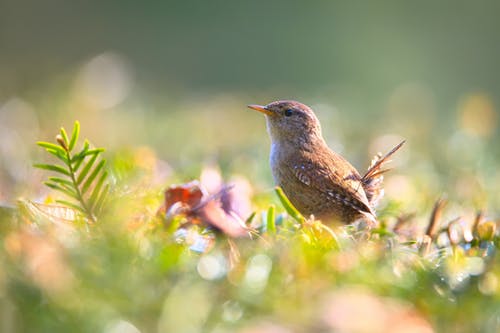
The other day when I was sitting at my desk, I noticed a slight movement outside.  I looked out the window, and I saw a small bird standing on a beam under the eave.  The movement I’d seen was the bird flying to that spot.  And right beside the bird was a nest which, as I was watching, the bird settled into.  It’s spring as I write this and perhaps there are eggs in the nest, or soon will be.

In addition to being impressed by the bird’s choice of a place to build the nest that is protected from wind and rain and predators, seeing that little bird in its nest reminded me of the quality of patience.  It is instinctual of course for birds to spend however much time is needed being still keeping their eggs warm until it’s time for their chicks to hatch.  For many people, such patience doesn’t come so naturally.  I consider myself to be a generally patient person, but then I catch myself at times when that isn’t so.  As when the person in the car ahead of me isn’t watching the light change and I feel some tension as I wait for them to get going.  Or when I go to a meeting and, because some people aren’t on time, the meeting starts late.

There are many life circumstances where having patience is essential.  Illnesses must run their course and we need to take care of ourselves as they do.  Injuries need a certain amount of time to heal, no matter how much we want to be active again.  Children at different ages and developmental levels are only able to do certain things, and it’s important for the children’s wellbeing that we as parents and caregivers recognize this.  Goals we set for ourselves require time as we work toward them.  These are just a few of many examples.

St. Augustine, a Christian theologian and philosopher who lived in the late fourth and early fifth centuries, wrote:  “Patience is the companion of wisdom.”  When life circumstances require us to be patient, it is in our best interest that we endeavor to be so.

Seeing that little bird in its nest is an example of how our connection with nature can provide moments of reflection.  For me, it also had synchronistic meaning.  Synchronicities are acausal meaningful occurrences.  I believe there is a reason I happened to be sitting where I was at a time the bird flew near the window and caught my attention.  For this took place during a period of time when some things are occurring that are not in my control, that may last for quite a while yet, and for which the outcome is uncertain, all of which require that I have greater patience than I’ve ever needed to have.  This synchronicity affirmed for me that waiting patiently is what I need to continue to do in my present situation.  Receiving that message helps me to do that, and I’m thankful the message was given to me.

Going Though the Darkness

“But I know, somehow, that only when it is dark enough can you see the stars.”

One of the things I pray for is courage, courage to face the challenges that come my way.  And courage to embrace the truth that challenges and difficulties are an essential aspect of living.  As much as I know intellectually and from experience that there are times when we all must grieve the passing of loves ones, feel the disappointment of unexpected setbacks, experience illness, and deal with other challenges, there is a part of me that questions why this must be so.  The words of Dr. Martin Luther King, Jr. which I quoted above help me to see that there is a purpose to enduring hardship.

Dr. King and many other people displayed great courage during the civil rights movement.  Their brave words and actions and their perseverance paved the way for many people to have more opportunities and better lives.  Their example gives us guidance and hope.  As does the life of Harriett Tubman.  She endured much suffering when she was a slave, was able to escape, and then, at significant risk to herself, helped many other people escape slavery through the underground railroad.  Other people also risked their lives to help people gain freedom in this way.

The Jungian concept of individuation where we become more whole and self-actualized persons through the integration of unconscious content into consciousness certainly involves challenges.  We become aware of unconscious content from dreams, synchronicities, intuition, and meaningful life experiences, and this awareness often requires that we take actions that are difficult to do.  The difficulty is caused by our egos not wanting to follow the direction of the Self or inner voice.  It’s hard for our egos to give up control, even though in reality that sense of control is illusory.  In order to continue to grow in consciousness and therefore to have more meaningful lives, however, it is essential that we do our best to follow the inner direction we discern, despite our fears.  Just as Harriett Tubman, Martin Luther King, Jr., and many others have done.

By doing so, we go through the darkness that leads to the starlight.