Nonattachment

Clouds above the mountains

An author whose books have meant a lot to me is Terry Chitwood, a Jungian psychotherapist and writer. In his book How to Defend Yourself Without Even Trying, Dr. Chitwood says this about nonattachment: “Everything in this world changes. To resist change is useless and time-consuming. In order to live effortlessly and happily, you need to flow with your changes. The only other choice is suffering.”

When I think of “flowing with my changes,” I’m reminded of those times when what I was doing felt exactly right and as if it was being supported by the universe. What I was doing wasn’t based on choices my ego made but rather was my ego being in the service of a presence larger than it. As much as I believe that, based on my personal experience and reading, trying to discern life direction from dreams and synchronicities is essential to living a meaningful life, I often have to deal with my resistance when the direction I discern requires making changes. There is that part of me who wants to hold on to the familiar. And holding on, of course, is the opposite of nonattachment.

And yet each time I recognize my resistance and, in spite of it, try to follow the direction I’ve been given, it feels right again. And I am given the gift of flowing with my changes.

Being Thankful

water fall

Sometimes before I go to sleep at night I have the thought that I was given the gift of living another day. One cannot know which day will be his or her last one of this earthly journey. Or whether this day will be the last day he or she doesn’t have a serious illness or isn’t disabled in an accident. I don’t mean to sound melodramatic or pessimistic. I mean to be thankful. And I am thankful for each day I get to walk and pray and think and work and interact with people and love others, and do many, many more things that are so easily taken for granted. There is much to be thankful for. And if a serious illness or disability happens, I pray I will have the courage and peace that our Creator gives to do my best to live with the challenge. And to continue to be thankful for all that I have.

We Are All Interconnected

candle light

There is a story called the “Allegory of the Long Spoons.” This parable is attributed by many to Rabbi Haim of Romshishok and, although there are variations to how it is told, here’s the basic story: A man asked God what heaven and hell were like. God showed the man a room where many people were seated around a large table and in the middle of the table was a big bowl of delicious, aromatic stew. But the people sitting around the table were sickly, thin, and miserable. Everyone around the table was holding a spoon with a very long handle and was able to take a spoonful of the stew, but because the spoon handles were longer than their arms, no one was able to put the stew in his or her mouth. God told the man, “This is hell.”

Then God showed the man a different room where again many people were sitting around a large table that had the same delicious stew in a big bowl in the center and all were holding the same type of long-handled spoons. But in this room the people were healthy, well nourished, and happy. For in this room, the people were reaching the spoonfuls of stew across the table and feeding each other. God told the man, “This is heaven.”

I first heard this allegory a few years ago and I love how it says so much in just a few words. I have read that this story is present in many cultures and referred to by many religious traditions. My work as a crisis line counselor includes giving callers resource information when I believe it could benefit them based on what they have shared with me in our call together. Although I’m impressed by the many organizations and religious institutions that have programs that help many people, I’m also concerned that there are a lot of people who don’t appear to care about helping others. The allegory of the long spoons portrays love, caring, and the interconnectness of people. We need one another. We need to use the abilities the Creator has given each of us to honor this interconnectedness.

The Gift of Humility

white flowers

In his book Meeting Force With Silence, author and Jungian psychotherapist Dr. Terry Chitwood writes, “If you are fortunate, you have already been gifted with humility. Treasure this gift.” It is so easy to take things for granted, including positive qualities such as humility. To live honestly we need to recognize that our creativity, intellectual ability, talents, accomplishments, health, and the many other attributes that make each of us a unique person, a unique creation, are gifts from the Creator. And for those of us who put effort into improving ourselves, such as by having the discipline to do what is needed to develop a talent we’ve been given or to do physical exercise regularly to maintain and improve our health, we need to recognize that that discipline is also a gift from the Creator.

Dr. Chitwood also writes “Humility is a necessity, not a virtue.” If our egos are lacking humility, they do not recognize a power greater than themselves. This is unnatural, and at some point the universe will try to correct such inflated egos by requiring them to go through painful experiences. Having humility is necessary in order for us to recognize and honor the source of our being. And by being humble we are better able to be thankful for all that we have been given.

Let It Be

This morning as I was getting ready for work, my mind was occupied with a decision I need to make. I kept going over scenarios and was feeling some stress because it wasn’t clear to me yet what the answer was. Then the words and melody of the Beatles song “Let It Be” came into my thoughts: “Let it be, let it be, let it be, let it be. There will be an answer, let it be.” I realized it was time to stop thinking about what was concerning me for now, to “give it a rest,” so to speak. The words of the song were also a reminder that there will be an answer.

The song “Let It Be” presented itself to me; I didn’t consciously bring it to mind. Hearing those words and that melody helped me to remember to be open to answers that come from within. In our culture reasoning and logical thinking are emphasized. Although these abilities are useful in certain situations, the answers to personal problems come from the creative, intuitive part of oneself. They are the answers that come from the heart, not from the head.

Facing Challenges

lake surrounded by trees

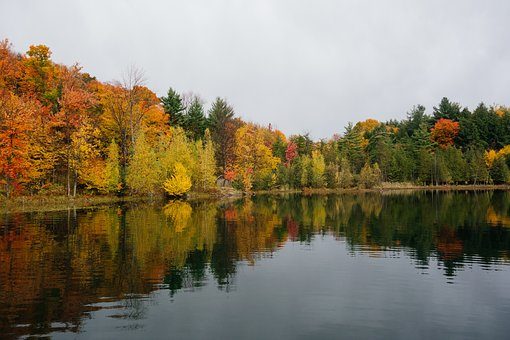
Today as I was driving I noticed how some of the leaves are changing color. I’m fortunate that, although I live in an urban area, there are many trees and a variety of types of trees so that in the next few weeks I will see more and more changes. Shades of gold, orange, and red intermixed with the green of the pine trees. Although generally I enjoy the changes of seasons, I have to admit I sometimes dread the coming of winter, with its cold temperatures and fewer hours of sunlight. So I have mixed feelings about the coming of fall again because it signals the coming of winter. But fall certainly is a very pretty time of the year.

The seasons are symbolic of many things. The seasons reflect the stages of life, from a baby being in the spring of life to an elderly person being in the winter of life. Thinking about the seasons also reminds me of dealing with the challenges I must face from time to time, those challenges that help me to become more whole. Just as I don’t look forward to winter, I don’t look forward to dealing with difficulties. I recognize that they are part of the reality of life, and I acknowledge that they help me to change in positive ways, but I still don’t look forward to them. And yet, once I have faced and dealt with a difficult situation to the best of my ability, I get to feel good about myself and to sense the inner change that has taken place. For after winter comes spring, a time of rebirth and renewal.

We Are Cared For

sparrows on white sand

As I was walking from the bus to my work this morning, a sparrow flew down onto the sidewalk a little ways from me. When I see a sparrow I’m reminded of the verse in the Bible, Matthew 6:26, that speaks of the birds of the air that do not sow and reap but instead the Creator provides for them, and our Creator provides for us as human beings as well. Obviously that is not a direct quote from a certain translation of the Bible, but that’s the idea. And although that verse speaks of birds in general, not just sparrows, for me it’s the sparrow that reminds me of the idea expressed. I think this might be because sparrows are not showy birds: they’re small, not as colorful as many other birds are, there are many of them so they are not a rare species, and they live in many types of habitats, both in the countryside and in cities. Kind of like human beings. Most of us are not showy either: we lives our lives, do our work, try to fulfill our responsibilities, and hopefully have people who we love and who love us.

It helps me to be reminded that the Creator takes care of me, especially when I find myself worrying about something. I believe it’s important that I try to discern what the Creator wants me to do and that I make an effort to do whatever that is. As I have written in other posts, I have found that doing Jungian dreamwork is one way of discerning this. And in addition it’s important that I realize I’m never alone in those endeavors. And most importantly I must always remember that whatever I do accomplish is only possible because the Creator makes it possible.

Perseverance

In my work as a crisis line counselor, I speak with callers of various ages and who have a variety of concerns.  A concern that comes up frequently is struggles with addiction.  Callers have reached the point where they know their addiction is hurting themselves and others and they want to stop–whether it be alcohol, other drugs, gambling, cutting, and/or other behaviors.  It is very difficult to stop doing a behavior that has become addictive.  But thankfully many people have succeeded in maintaining sobriety; there are many success stories.  I respect people who work hard to stop their addictive behavior in order to make their lives and the lives of the people they love better.  Knowing that others have succeeded can bring hope to those who are trying to stop.

It is generally difficult for a person to do this without the assistance of other people.  There are 12-step programs for all types of addictions that help people stop the behavior and also provide ongoing support to decrease the chances of them starting again.  For some people, doing individual work with a therapist is what helps most.  Others have found the help they needed by attending a residential treatment program.  No matter what type of assistance is provided, it is the person who has the addiction who does the difficult work of taking the steps toward sobriety; he or she perseveres.

Perseverance is a quality that is essential to living life well.  Although in this post I’ve focused on the difficulties of addiction, perseverance is needed to deal with every type of challenge.  Life naturally gives us challenges, and doing our best to make the right choices, to have courage as we follow through on those choices, and to accept the suffering that often accompanies doing the right thing all require perseverance.  And when we’ve made it through that period of difficulty by doing what we knew was right, we will have grown as individuals.